Key Takeaways
- Form 1099-A has no minimum dollar reporting threshold. The form applies to all amounts when the filing conditions are met.
- Form 1099-A reporting is required when a lender takes ownership of property that secured a loan, such as through foreclosure, property acquisitions in satisfaction of debt, and abandonments of secured property.
- When both a property acquisition and a qualifying debt cancellation occur in the same year, Form 1099-C may satisfy the Form 1099-A requirement if the Form 1099-C reporting requirements are met and Boxes 4, 5, and 7 are completed as required.
- For TY 2026, the recipient copy of Form 1099-A is due February 1, 2027, paper filing is due March 1, 2027, and electronic filing is due March 31, 2027.
What Is Form 1099-A?
Form 1099-A, Acquisition or Abandonment of Secured Property, is an IRS information return that lenders use to report when they acquire an interest in property that secures a debt or when they have reason to know that a borrower has abandoned the property. The Form 1099-A filing requirements apply regardless of the dollar amount involved and even when lending is not the filer’s primary business.
The reporting applies to residential or commercial real estate, business or investment property, certain tangible personal property used for business or investment purposes, certain intangible property, and property securing loans made by government agencies.
However, a personal-use tangible property that secures an individual loan (such as a car) and is intended for personal use is not reportable.
When Is Form 1099-A Required?
Understanding who must file Form 1099-A starts with two triggering events: a lender files the form in the year following the year in which it acquires an interest in secured property in full or partial satisfaction of a debt, or has a reason to know that the property has been abandoned.
When it comes to abandonment, Form 1099-A considers it abandonment only when the objective facts show that the borrower intended to, and has permanently discarded the property from use.
| Filing Situation | Is Form 1099-A Filed? |
|---|---|
| Lender acquires secured property through foreclosure | File Form 1099-A. |
| Borrower abandons the secured property | File Form 1099-A when the lender knows the reason for abandonment. |
| Government lender acquires secured property | File Form 1099-A. |
| Personal-use tangible property secures an individual loan | Not reportable on Form 1099-A. |
| Acquisition and reportable debt cancellation occur in the same year | Form 1099-C may satisfy the Form 1099-A requirement if Boxes 4, 5, and 7 are completed. |
Situations Where Form 1099-C Replaces Form 1099-A
Form 1099-A vs Form 1099-C comes down to the events that occurred. Form 1099-A covers the acquisition or abandonment of secured property, while Form 1099-C covers the cancellation of the debt.
When both a property acquisition or abandonment and a qualifying debt cancellation of $600 or more happen for the same borrower in the same year, a Form 1099-C can satisfy the Form 1099-A reporting requirement. If you file both forms for the same borrower, do not complete Boxes 4, 5, and 7 on Form 1099-C.
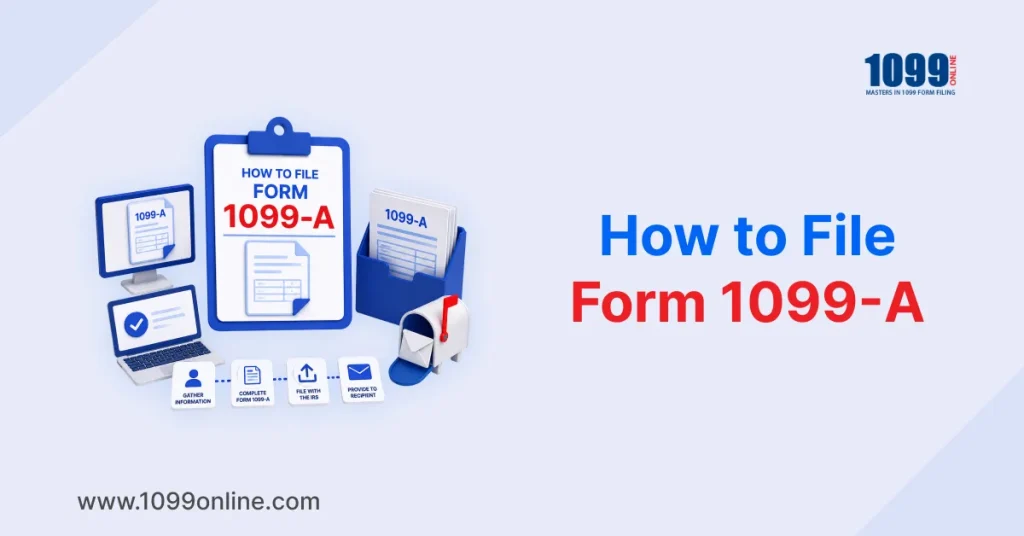
How to File Form 1099-A: A Step-by-Step Filing Guide
Step 1: Collect lender and borrower details
The first step in filing Form 1099-A is to collect lender details, borrower details, loan records, property records, and any foreclosure or abandonment documentation.
Step 2: Enter the lender information
Prepare the return by entering the required lender’s legal name, address, TIN, and contact information.
Step 3: Enter the borrower information
The next step is to enter the borrower’s legal name, address, TIN, and account number.
Step 4: Report in the correct Form 1099-A Box
- Box 1: Report the date the lender acquired the property or first knew of the abandonment
- Box 2: Report the balance of principal outstanding (do not include accrued interest or foreclosure costs)
- Box 4: Report the fair market value of the property when required
- Box 5: Report whether the borrower was personally liable for repayment of the debt
- Box 6: Add the description of the property, including the address.
Step 5: Review Form 1099-A
Before submitting the form, verify that all lender and borrower details are correct, TINs are accurate, the acquisition or abandonment date is right, the principal balance excludes interest and fees, the FMV is entered where required, the borrower’s liability status is marked, and the property description is complete.
Step 6: Submit the return filing method
Determine whether to file Form 1099-A online through IRIS or submit on paper based on your filing volume. If you file 10 or more information returns in aggregate, electronic filing is required. After submitting, save the acceptance confirmation or paper filing records for your files.
Step 7: Furnish the borrower with a copy
Provide the required Form 1099-A statement to the borrower on or before the recipient copy distribution deadline.
Form 1099-A Filing Deadlines for 2026TY (Filed in 2027)
| Filing Type | Form 1099-A Deadline for 2027 Filing Season |
|---|---|
| Furnish Form 1099-A to the borrower | February 1, 2027* |
| File Form 1099-A on paper | March 1, 2027* |
| eFile Form 1099-A | March 31, 2027 |
*January 31 and February 28 (the usual deadlines) fall on the weekend in 2027, so these deadlines have been shifted to the next business day.
Filing Extension Note
An automatic 30-day filing extension may be requested using Form 8809 by the filing deadline.
How 1099Online Helps with Form 1099-A Filing
1099Online is an IRS-approved eFiling platform that brings preparation, validation, delivery, and tracking into one single platform to help you fulfill Form 1099-A filing requirements.
- Upload and manage lender and borrower information in bulk via templates or manually
- Complete Form 1099-A filing using a guided filing workflow
- Validate filing data and catch errors before submission using Real-Time TIN Match
- Manage multiple Form 1099-A filings from a single account
- Deliver borrower copies by print and mail via USPS, email copies, or download PDFs.
- Track filing status and maintain records from your dashboard
Form 1099-A Filing Scenarios
| Scenario | What Happens | How to Report |
|---|---|---|
| A bank forecloses on a residential property and takes ownership | The lender acquired secured property in satisfaction of the debt. | File Form 1099-A. Complete Boxes 1, 2, 4, 5, and 6 with the acquisition date, outstanding principal, FMV, liability status, and property address. |
| A borrower walks away from a commercial warehouse and stops all maintenance | The lender becomes aware of a permanent abandonment. | File Form 1099-A once the lender knows or has reason to know. Use the same boxes with the date the lender learned of the abandonment. |
| A state housing authority forecloses on a loan it originated | Government lenders are subject to the same reporting rules as private lenders. | File Form 1099-A with the applicable acquisition and debt details. |
| A credit union forecloses on a property and cancels $12,000 of remaining debt in the same year | Both a property acquisition and a qualifying debt cancellation occurred in the same calendar year. | File Form 1099-C with Boxes 4, 5, and 7 completed. A separate Form 1099-A is not required. |
| A borrower defaults on a personal car loan used only for commuting | The vehicle is personal-use tangible property securing an individual loan. | No Form 1099-A is required under the personal-use exception. |
FAQs
1. Is there a minimum dollar threshold for Form 1099-A?
No. Form 1099-A filing is required for all amounts when the acquisition or abandonment conditions are met.
2. Can Form 1099-A be filed electronically?
Yes, Form 1099-A can be filed electronically. Starting from the 2027 filing season, IRIS will become the sole information return intake system.
3. Do I need Form 1096 when filing Form 1099-A electronically?
No. Form 1096 is a transmittal for paper-filed information returns and is not used with electronic submissions.
4. Does the borrower receive a copy of Form 1099-A?
Yes. A copy or acceptable substitute statement must be furnished to each borrower.
5. Can a borrower’s TIN be truncated?
Yes, a borrower’s TIN can be truncated on the borrower statement. Truncation is not permitted on the return filed with the IRS.
6. Is Form 1099-A required when the debt is also canceled?
If a lender cancels $600 or more of debt in connection with a foreclosure or abandonment in the same calendar year, it may file Form 1099-C instead of Form 1099-A by completing Boxes 4, 5, and 7. If both forms are filed, leave Boxes 4, 5, and 7 of Form 1099-C blank.
Complete Form 1099-A filing with 1099Online.
Get built-in validations, bulk import, TIN match, and secure eFiling in one place