Key Takeaways
- The federal reporting threshold for Forms 1099-NEC and many 1099-MISC payments increases from $600 to $2,000, starting the 2026 tax year. However, the $2,000 threshold does not apply to every 1099 payment type.
- Certain payment types, such as royalties and other specialized reporting categories, may have separate statutory thresholds or reporting requirements that differ from the new $2,000 standard.
- Form 1099-K has its own rule: third-party network transactions generally require reporting only when payments exceed $20,000 and 200 transactions, while payment card transactions remain reportable with no minimum threshold.
- Backup withholding at 24% can still require reporting below the usual threshold.
“1099 thresholds” aren’t one-size-fits-all. This guide explains how the rules differ across the common forms, what payments do and don’t count, and what to watch for with recipient furnishing and state copies as you track 2026 payments.
Why Are 1099 Filing Thresholds Important for 2026 Payments?
The IRS uses 1099 thresholds to determine when different types of business payments must be reported. The thresholds reduce unnecessary filing for smaller payments while helping the IRS match reportable payments with the income recipients report on their tax returns.
Businesses may face penalties when a required information return is filed late, contains incorrect information, or is not filed at all. As a reference point, for returns due in 2026, late-filing penalties generally ranged from $60 to $340 per return, and intentional disregard could result in a penalty of at least $680 per return with no maximum limit. Penalty amounts are adjusted periodically, so businesses should confirm the applicable rates for the filing year.
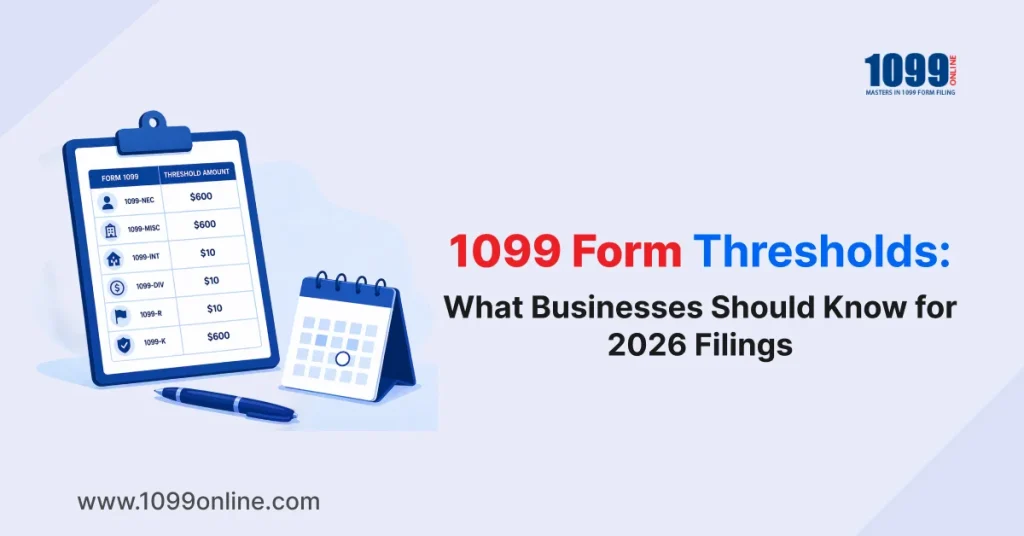
Federal Dollar Limits for 1099 Forms at a Glance
| Form | Payment Type | Standard Threshold | No-Threshold Triggers/Notes |
|---|---|---|---|
| 1099-NEC | Nonemployee compensation (Box 1) | $2,000 for payments made in 2026 and reported in 2027 | Direct sales of $5,000 or more are reported using Form 1099-NEC, Box 2, or Form 1099-MISC, Box 7. The direct sales checkbox does not by itself trigger backup withholding. Backup withholding at 24% applies only when required, such as when a TIN is missing or incorrect or the IRS has issued an applicable notice. If backup withholding applies, the payment must be reported even when it is below $2,000. |
| 1099-MISC | Rents (Box 1), royalties (Box 2), other income, prizes and awards (Box 3), medical and health care payments (Box 6), substitute payments (Box 8), crop insurance proceeds (Box 9), gross proceeds paid to attorneys (Box 10), cash payments for fish purchased for resale, fishing boat proceeds, and direct sales | Varies by payment type | For payments made in 2026, rents, applicable Box 3 payments, medical and health care payments, and crop insurance proceeds are generally reportable at $2,000 or more. Royalties and substitute payments remain reportable at $10 or more. Gross proceeds paid to attorneys and cash payments for fish purchased for resale remain reportable at $600 or more. Fishing boat proceeds are reportable at any amount, while direct sales remain subject to a $5,000 threshold. |
| 1099-INT | Interest reported in Boxes 1, 3, and 8 | Generally $10; $2,000 in certain cases involving payments subject to the general business-payment reporting rule | A return is still required below the applicable threshold if federal income tax was withheld under the backup withholding rules or foreign tax was paid on the interest. |
| 1099-DIV | Dividends (Box 1a), capital gain distributions (Box 2a), and liquidation distributions | $10 for dividends and capital gain distributions; $2,000 for liquidation distributions for payments made in 2026 | File for any amount if federal income tax was withheld or foreign tax was paid. |
| 1099-K | TPSO / payment-card and marketplace payments | TPSO: > $20,000 and > 200 transactions; payment-card transactions remain reportable with no de minimis threshold | The $20,000 and 200-transaction test applies only to third-party network transactions. Payment card transactions have no de minimis threshold. If backup withholding is taken, file regardless of the amount. |
| 1099-A | Acquisition or abandonment of secured property (lender reporting) | No dollar threshold | File when the lender acquires an interest in the secured property or knows of abandonment. If, in the same calendar year, a debt of $600 or more is canceled in connection with the foreclosure or abandonment, you may file only Form 1099-C. Completing Boxes 4, 5, and 7 on Form 1099-C satisfies the Form 1099-A requirement. |
| 1099-B | Proceeds from broker and barter exchange transactions | No dollar threshold | Brokers file Form 1099-B for each sale or exchange of securities and for barter exchange transactions. For covered securities, report the cost basis and applicable adjustments. |
| 1099-C | Cancellation of debt | $600 in canceled debt | File when a reportable identifiable event occurs. See the coordination rule with Form 1099-A above. |
| 1099-PATR | Taxable distributions from cooperatives | $10 | File for any amount if backup withholding occurred. |
| 1099-S | Gross proceeds from real estate transactions and certain royalty payments | Generally $600 or more | Beginning with tax year 2026, digital assets used in the sale or exchange of real estate are also reported on Form 1099-S. Limited exceptions may apply to certain transactions, including qualifying principal-residence sales. |
| 1042-S | U.S.-source income paid to foreign persons | No dollar threshold | Report any amount of U.S.-source income subject to Chapters 3 or 4, even if the withholding rate is reduced by a treaty or no tax was withheld. |
When Does the 1099 Form’s Dollar Limit Apply?
The dollar limit applies when your calendar-year total paid to the same recipient for the specific payment category on that form meets or exceeds the threshold for a payee.
Do note:
Backup withholding at 24% requires you to file the appropriate 1099 form regardless of the amount. Report the federal income tax withheld in the form’s federal income tax withheld field, such as Box 4 on Forms 1099-NEC, 1099-MISC, 1099-INT, 1099-DIV, and 1099-K.
“Royalty” generally applies to minerals, music, and publishing rights, which translates to a threshold of $10 on Form 1099-MISC, Box 2.
Attorney gross proceeds of $600 or more are reported on Form 1099-MISC, Box 10. This rule also applies to payments made to incorporated law firms. Attorney fees for services are reported on Form 1099-NEC, Box 1.
Forms with no dollar threshold, such as Forms 1099-A, 1099-B, and 1042-S, are filed whenever the event that triggers reporting occurs, regardless of the amount. Form 1099-S is different: gross proceeds from real estate transactions and certain royalty payments are generally reportable at $600 or more.
Aggregation & Special Tests
Calendar-year aggregation: Aggregate all payments to each recipient for the year.
Multiple form triggers: The same recipient may require multiple forms, so keep that in mind and account for it.
Split payments: Include all amounts you pay directly for services, including cash, checks, ACH payments, or noncash payments valued at fair market value. Do not include amounts paid by credit card or through a third-party network in the payer’s Form 1099-NEC or Form 1099-MISC threshold calculation.
When a vendor is paid through more than one payment method, count only the amounts the business paid directly when checking whether the Form 1099-NEC or Form 1099-MISC threshold was met. For example, suppose a contractor receives $1,700 by ACH and $700 by credit card. The credit card processor handles reporting for the $700 payment, so the business should not add it to the ACH payments when checking the Form 1099-NEC threshold. If the direct payments alone meet the applicable threshold, report only the directly paid amount.
State-Level Variations
Each state sets its own 1099 thresholds and filing rules. The IRS does not have a formal category of “federal conforming” states for this purpose. The new federal $2,000 threshold for payments made in 2026 does not automatically replace state-specific thresholds or rules that require filing when state tax is withheld. Some states require direct filing or apply different thresholds. Here are some examples:
- Connecticut requires filing Forms 1099-MISC and 1099-NEC for residents and for nonresidents when services are performed wholly or partly in Connecticut, even if no Connecticut income tax was withheld. Form 1099-R for nonresidents is required only if Connecticut tax was withheld.
- The District of Columbia requires copies of federal Form 1099 to report $600 or more, or amounts subject to District of Columbia withholding, for District of Columbia residents.
- Florida requires only Form 1099-K to be filed with the state under the thresholds in section 6050W.
- New Jersey generally requires filing when the amount paid or credited is $1,000 or more during the calendar year or when New Jersey income tax was withheld.
State sourcing rules vary, but many states source nonemployee compensation based on where the services were performed.
Compliance Checklist for Payers
Taking note of these will help you stay compliant:
- Before making the first payment, obtain a Form W-9 and verify it. To help prevent B Notices, you should also match TINs.
- Throughout the year, track the total payments made under each recipient’s TIN. Accounting software can help flag payments approaching a reporting threshold.
- For a missing or obviously incorrect TIN, begin backup withholding immediately if required. A name/TIN mismatch reported on a CP2100 or CP2100A notice does not always require immediate withholding. Review the notice, send the appropriate B Notice, and begin backup withholding if the payee does not provide the required certification within the allowed period.
- If you are required to file 10 or more information returns during the year in aggregate across all return types, you must e-file. Paper filing is allowed only if you file fewer than 10 returns or receive an approved waiver.
- Mark the important due dates on your calendar:
| Requirement | Statutory/general due date | 2026 filing season actual date for 2025 payments | 2027 filing season actual date for 2026 payments |
|---|---|---|---|
| Furnish most 1099 recipient statements | January 31 | February 2, 2026 | February 1, 2027 |
| Furnish Forms 1099-B, 1099-DA, 1099-S, and Form 1099-MISC statements reporting Boxes 8 or 10 | February 15 | February 17, 2026 | February 16, 2027 |
| File Form 1099-NEC with the IRS, paper or electronic | January 31 | February 2, 2026 | February 1, 2027 |
| File most other 1099 forms with the IRS on paper | February 28 | March 2, 2026 | March 1, 2027 |
| File most other 1099 forms with the IRS electronically | March 31 | March 31, 2026 | March 31, 2027 |
- Keep federal 1099 records for at least three years from the due date. Keep records for four years if backup withholding was imposed and for Form 1099-C.
Real-Life Scenarios
| Payment Scenario | Year-to-Date Amount | 2025 Payments: Threshold Met? | 2026 Payments: Threshold Met? | Required Form/Box |
|---|---|---|---|---|
| Three design invoices paid directly to a contractor | $1,800 | Yes | No, unless backup withholding applies | Form 1099-NEC, Box 1 for 2025 payments; none for 2026 payments unless backup withholding applies |
| Four photography jobs paid directly to a contractor | $2,200 | Yes | Yes | Form 1099-NEC, Box 1 |
| Bank interest with 24% tax withheld | $9 | No, but reporting is required because of backup withholding | No, but reporting is required because of backup withholding | Form 1099-INT, Boxes 1 and 4 |
| Catalog kits sold for resale | $5,500 | Yes | Yes | Form 1099-NEC, Box 2, or Form 1099-MISC, Box 7—the direct-sales checkbox only, with no dollar amount |
| Settlement paid to the attorney | $40,000 | Yes | Yes | Form 1099-MISC, Box 10 |
Note: For 2025 payments, many Form 1099-NEC payments were reportable at $600 or more. For 2026 payments, the threshold generally increases to $2,000 for nonemployee compensation. Some thresholds, including direct sales and gross proceeds paid to attorneys, remain unchanged.
FAQs
1. Must a payer issue a 1099 form for every payment of $2,000 or more?
No, not for every payment. The updated $2,000 threshold applies only to certain payment categories, including Form 1099-NEC nonemployee compensation and selected Form 1099-MISC payments. Personal payments are generally not reportable, and there are some business-payment categories still with lower thresholds.
2. Is interest under $10 ever reportable by a payer?
Yes. File Form 1099-INT if you withheld any federal income tax under backup withholding or paid any foreign tax on the interest, regardless of the dollar amount.
3. Do corporations ever receive 1099s from a payer?
Generally, payers don’t issue Forms 1099-NEC or 1099-MISC to corporations. Exceptions include medical and health care payments reported on Form 1099-MISC, Box 6; attorney fees for services reported on Form 1099-NEC, Box 1; and gross proceeds paid to attorneys reported on Form 1099-MISC, Box 10. Form 1099-K is issued by the payment settlement entity, not by the payer.
4. How does the 10-return e-file mandate affect a payer?
If you are required to file 10 or more information returns in aggregate across all return types for the year, you must e-file. Paper filing is allowed only if you file fewer than 10 returns or have an approved waiver.
5. What should a payer do after discovering an incorrect threshold filing?
File a corrected return to fix an error on a return that has already been filed. If a required return was omitted, file the original return as soon as possible.
6. Are accountable-plan reimbursements counted toward a payer’s thresholds?
Accountable plan rules apply to employees. Qualifying reimbursements are excluded from wages and are not reported on Form 1099. For contractors and other nonemployees, reimbursements are generally included in nonemployee compensation and count toward the $2,000 Form 1099-NEC threshold for payments made in 2026 and reported in 2027. Backup withholding can still require reporting below $2,000.
7. Does a payer aggregate payments across multiple subsidiaries?
Only if the subsidiaries use the same EIN. Even when they have a common parent company, subsidiaries with separate EINs generally handle their reporting separately.
The Bottom Line
Keep track of your payments and 1099 thresholds throughout the year and e-file 1099s accurately when triggers are hit. With 1099Online, payers can import payee data, verify TINs, and file Forms 1099 with the IRS using IRIS with a valid Transmitter Control Code, in line with IRS e-file specifications.
Need a simpler way to file your 1099 forms?
Use 1099Online to electronically file information returns and keep your filing records organized year-round.