Key Takeaways
- Attorney fees paid in 2026 by a business for legal work generally need to be reported on Form 1099-NEC once the total payments for the year reach $2,000.
- Legal services are an exception to the usual corporate exemption. Payments to an incorporated law firm may still need to be reported on Form 1099-NEC when the reporting threshold is met.
- Form 1099-NEC is used for attorney fees, so not every payment connected with a legal matter belongs there.
- Gross proceeds paid to an attorney generally go in Box 10 of Form 1099-MISC rather than on 1099-NEC.
- Legal fees paid by card or through a third-party payment platform are usually reported on Form 1099-K by the payment processor and should not be reported again on Form 1099-NEC.
If you are paying lawyers, you might have to be a tad more careful when filing 1099s. Should you be paying 1099-NEC for legal services or 1099-MISC? This confusion is pretty normal.
In this blog we will tell you all about filing the right form when you pay for legal work. The difference between 1099-NEC and 1099-MISC, thresholds, exceptions, deadlines and the mistakes you must avoid.
It’s important to make sure that these payment records are accurate so that you don’t face any compliance issues later. Stay with us.
Form 1099-NEC Vs Form 1099-MISC
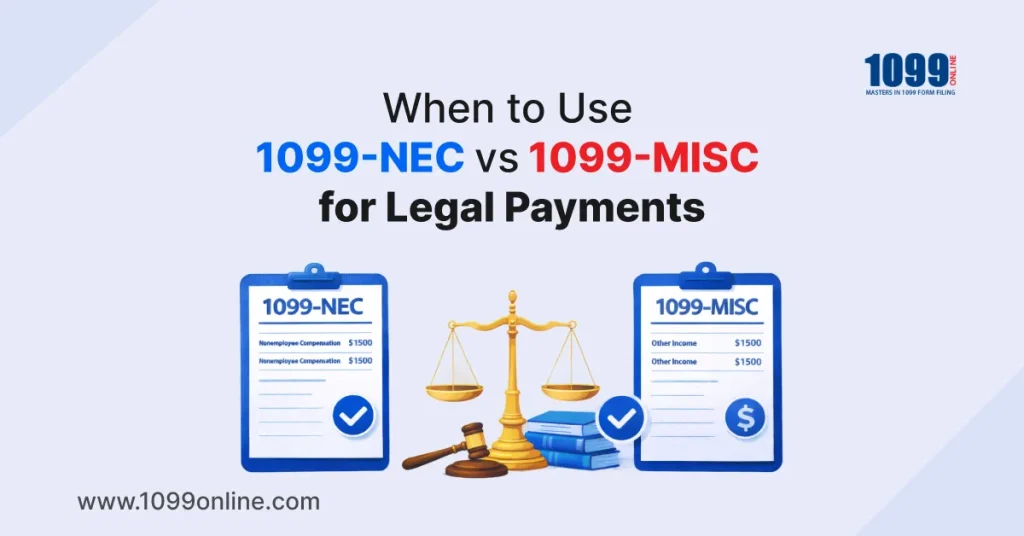
If your business has paid a lawyer or law firm, you might be confused about whether you should file Form 1099-NEC or 1099-MISC. Deciding which one to file is not difficult and depends on one crucial question. Are you paying for attorney services or is it settlement proceeds?
File Form 1099-NEC (Nonemployee Compensation) if you’re paying for attorney fees in the course of your trade or business. The total must be $2,000 or more for payments made in 2026 ($600 for 2025). If you meet the criteria, report this in Box 1a on Form 1099-NEC.
But here’s a twist. You must file a 1099-NEC even if the law firm is a corporation. What about the corporate exception? That doesn’t apply to legal services.
What if you’re paying an attorney in connection with legal services? Such as when you’re settling a lawsuit and the attorney is receiving funds on behalf of someone else?
This doesn’t go on 1099-NEC and is instead reported on 1099-MISC (Box 10). The threshold for gross proceeds paid to an attorney is $600 for payments made in 2026.
Exceptions You Must Know
Not every payment made to lawyers needs 1099-NEC reporting. For example, full-time employees get wages and Form W-2. They don’t need 1099s.
Another instance is when you pay via credit/debit card or using third-party payment platforms. These are usually reported on Form 1099-K by the payment settlement entities. So? No 1099-NEC or 1099-MISC is needed.
Suppose you’re dealing with foreign attorneys. If they’re able to provide a valid W-8 form to prove their foreign status this doesn’t need 1099 reporting.
But if the payment is from a U.S. source income then you might have to file Form 1042-S and withhold the appropriate amount of tax based on the tax treaty.
Another exception is when the payment is under the threshold for the year or the payment is reimbursement made under an accountable plan (no income element).
Key Deadlines
The due dates to submit 2026 1099-NEC forms with the IRS and send copies to recipients are the same, i.e., February 1, 2027. The deadline is the same whether you paper-file or eFile.
Meanwhile, for 2026 1099-MISC (Box 10), the deadline to file on paper is March 1, 2027, and to file electronically, it is March 31, 2027. Also, the recipient copy is due by February 16, 2027 (with payments reported in Box 8 or Box 10) or February 1, 2027 (for amounts reported in other boxes)
If any of these dates fall on a weekend or a federal holiday. The deadline moves to the next business day.
Filing rules: The IRS mandates eFiling if you have 10 or more information returns in total, including 1099s, W-2s and others.
Payer Checklist
Here’s a checklist you can fall back on when your mind is all over the place and you don’t know where to start.
Step 1: Classify the payment
Ask yourself: “What’s this payment for?”
- If it is for attorney services: Form 1099-NEC (Box 1)
- If it’s settlement proceeds: Form 1099-MISC (Box 10)
Step 2: Collect Form W-9 and match TINs
Before you start filing, gather a completed W-9 from each payee. This form provides the legal name, address, TIN, entity type and other key details. Verify TIN and name combination with IRS records using the IRS TIN-match service.
If you encounter missing or incorrect TINs mark them as backup withholding accounts. And apply 24% backup withholding on payments to these vendors until they provide a valid TIN.
Step 3: Set up payment tracking by EIN/SSN
Your Accounts Payable or General Ledger should track all payments by vendor TIN (EIN or SSN) throughout the year. This helps in quickly identifying who crosses the reporting threshold instead of digging through invoices when tax season arrives.
Step 4: Keep vendor data clean
Update address or name changes in your system as soon as you receive updated W‑9s. Review vendor data quarterly so that you don’t use outdated information.
Step 5: Confirm payment method
Tag each payment by its payment method (ACH/check/wire/card/platform). Payment card transactions are usually reported by third party settlement entities. This prevents double-reporting.
Step 6: Prepare and file
After completing the forms with accurate information, file with the IRS and deliver recipient copies by the deadline to avoid penalties. Remember that eFiling is mandatory if you have 10 or more returns in total.
Step 7: Retain records
Always store copies of filed returns and supporting documentation for at least 4 years in case audits or corrections come up.
Common Mistakes to Avoid
Mistakes are inevitable. But it’s always better to know the common errors payers make so that you can be more vigilant when filing. Here are some examples:
- Using Form 1099-NEC for settlements instead of 1099-MISC.
Remember, use 1099-NEC for attorney fees and 1099-MISC (Box 10) for settlement proceeds. - Reporting debit or credit card payments on 1099-NEC and 1099-MISC.
Payment settlement entities should report them using Form 1099-K. - Thinking an incorporated law firm is exempt from 1099 reporting.
It doesn’t matter if the law firm is a corporation. Legal services are always reportable. - Forgetting the new 1099-NEC threshold for 2026 payments.
Under the OBBBA, the threshold increases to $2,000 from $600 in 2025. Payments for later years are indexed for inflation. - Failing to meet the deadlines.
If this happens, you’ll attract penalties starting from $60 per form, and it increases with time. Intentional disregard for 2027-filed information returns will cost you at least $690, with no maximum cap.
Real World Examples
Scenario 1
Your company pays a lawyer $5,000 via wire transfer in 2026 for drafting a contract. Since it’s a straightforward fee for services paid to an attorney, you’ll file Form 1099-NEC (Box 1a).
It also clears the updated threshold for 2026 payments.
Scenario 2
Your company pays a $200,000 check to the claimant’s attorney as part of the settlement. Here, evaluate if it is gross proceeds paid to an attorney. Then you must report it on Form 1099-MISC, Box 10 instead of 1099-NEC.
Scenario 3
You paid a law firm both fees for attorney services as well as settlement proceeds related to a litigation. Here, two different reporting rules might apply. The attorney fees go on 1099‑NEC (Box 1) while the settlement amount might need to be reported separately on 1099‑MISC (Box 10). Always review each payment carefully.
FAQs
1. If I paid a law firm using my credit card, should I file Form 1099-NEC?
No. The payment settlement entities take care of this payment by reporting it on Form 1099-K.
2. What if I make a mistake and discover it after filing the 1099-NEC form?
Don’t worry. You can file a Corrected Form 1099-NEC as soon you discover the error. Submit it to the IRS and send an updated copy to the recipient.
3. What if the law firm is a corporation?
You must file Form 1099-NEC if you made payments to attorneys of law firms even if they are incorporated.
4. Are there any state-level penalties, too?
Yes. States may impose their own penalties for missing or late filings.
5. What should I do if a lawyer refuses to provide a W-9 or TIN on time?
This becomes a serious compliance risk. Make sure that you follow-up with the payee to send a W-9 and document the correspondence. If the payee still doesn’t respond, you must apply backup withholding at 24% until you get it.
Attorney payments can trigger IRS scrutiny. Avoid costly filing mistakes and stay compliant with 1099Online.