Key Takeaways
- Banks, financial institutions, and other payers have to report interest payments crossing the $10 threshold for most interest types on Form 1099-INT and file it with the IRS and furnish copies to recipients.
- For some types of interest payments, the 1099-INT reporting threshold is $2000 for the 2026 tax year, like interest paid on delayed death benefits, legal settlement, etc.
- Backup withholding can require Form 1099-INT even when the interest paid is below $10 or $2000. It’s the same if foreign tax is withheld on interest.
- The filing threshold is only applicable to the payer’s reporting obligation and should not be confused with taxation figures. Recipients may still need to report taxable interest on their tax returns even if they do not receive Form 1099-INT.
If a business or financial institution has to pay interest during the year, the IRS requires the payment to be reported using Form 1099-INT.
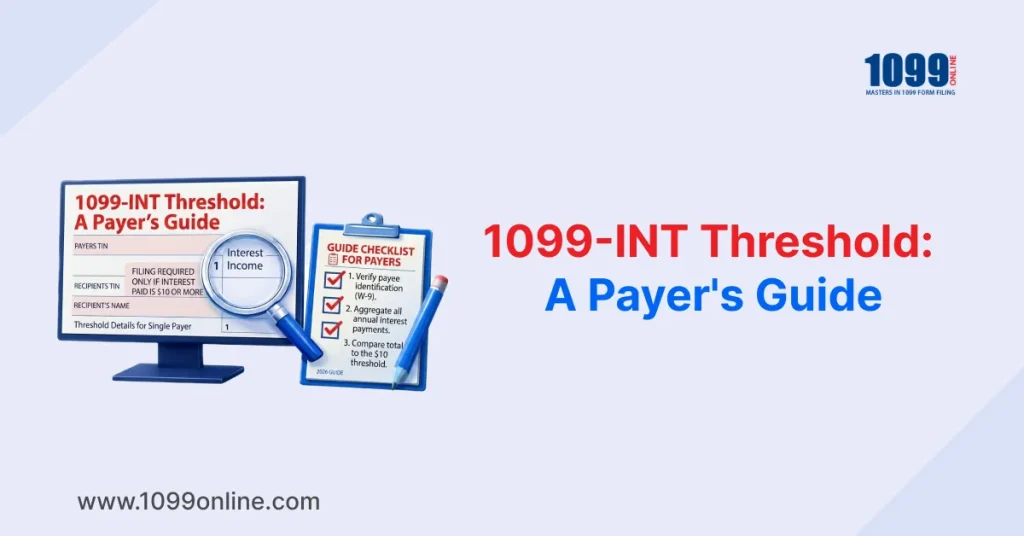
For 2026 TY, IRS Form 1099-INT threshold remains $10 or more ($2,000 or more in some cases). Getting the threshold right and reporting the applicable payments is important to stay compliant with IRS reporting requirements
This guide covers the current 1099-INT threshold rules for 2026, who must file, real-world examples, common mistakes, and the deadlines you need to meet.
What Is IRS Form 1099-INT?
Form 1099-INT, Interest Income, is an IRS information return used to report interest payments made to recipients during the calendar year. Payers have to send Copy A to the IRS and Copy B to the recipient. The IRS uses Copy A to match the interest income recipients report on their federal income tax returns.
Who Needs to Issue Form 1099-INT?
You are generally required to issue Form 1099-INT if you are:
- A bank or credit union that pays reportable interest to account holders or members
- A business paying reportable interest in the course of a trade or business
- A payer who withheld federal income tax under backup withholding rules
- A payer that withheld and paid foreign tax on interest
- A nominee or middleman receiving interest on behalf of another person
Note: Form 1099-INT threshold governs the payer’s filing obligation only. Recipients must report all taxable interest income on their federal return, even if no form was issued.
What Is Form 1099-INT Threshold in 2026?
For the 2026 tax year, there are 2 standard 1099-INT thresholds that filers need to know.
The $10 or more standard threshold
You must file Form 1099-INT for each recipient who received $10 or more of interest reportable in Box 1, Box 3, or Box 8 during a calendar year. This is the standard 1099-INT threshold that covers most of the common interest-paying situations, including bank deposit interest, credit union interest, savings and loan interest, CD earnings, Treasury and Savings Bond interest, and tax-exempt bond interest.
The $2,000 or more threshold for certain interest payments
A separate, higher 1099-INT threshold applies to interest paid in the course of a trade or business that does not qualify under the $10 rule. The IRS identifies specific examples: interest on delayed death benefits paid by a life insurance company, interest received in a legal damages settlement, interest on a state or federal income tax refund, and interest from certain notional principal contracts with nonperiodic payments. For all of these, the filing obligation is triggered at $2,000 or more.
Critical Exceptions Where the 1099-INT Threshold Is Irrelevant
There are a few situations where you must file Form 1099-INT regardless of the threshold. The 1099-INT threshold simply does not apply in these cases.
Backup withholding applied
If you withheld federal income tax from a recipient’s interest payment under backup withholding rules, you must file regardless of how small the payment was. Backup withholding at the 24% rate applies when a recipient fails to provide a valid TIN or when the IRS notifies you of a TIN mismatch. Report the withheld amount in Box 4 of the form.
Foreign tax withheld
If foreign tax was withheld and paid on any interest income, you must file Form 1099-INT for that recipient regardless of the payment amount. Report the foreign tax in Box 6 and the country or U.S. territory name in Box 7.
Nominee or middleman reporting
If you received interest income as a nominee or middleman for another person, you may have a nominee reporting obligation. In that case, you are required to issue a Form 1099-INT to the actual owner of the income.
Taxpayer reporting obligation
Even when a payer is not required to file because the payment is below the 1099-INT threshold, the recipient is still generally required to report all taxable interest income on their federal return. The threshold is a payer rule only.
Real-World Examples of When to Issue Form 1099-INT
These examples show how the 1099-INT threshold applies across common payer situations.
Example 1: A bank pays a customer $27 in savings account interest during the year. Since the payment meets the $10 standard threshold, the bank must issue Form 1099-INT and report the amount in Box 1.
Example 2: A payer issues only $8 of interest to a recipient, but federal backup withholding of 24% was applied because the recipient did not provide a TIN. The standard 1099-INT threshold does not apply here. But the payer must still file, reporting the interest in Box 1 and the withheld amount in Box 4.
Example 3: A business pays $2,750 in interest on a late invoice settlement during a trade or business activity. Since this exceeds the $2,000 business-interest threshold, the business must file Form 1099-INT and report the amount in Box 1.
Example 4: A brokerage credits a customer $15 in interest from U.S. Savings Bonds. Since the amount meets the $10 threshold and qualifies as government obligation interest, it must be reported in Box 3.
Mistakes to Avoid When Filing Form 1099-INT
Understanding the 1099-INT threshold also means knowing where payers commonly go wrong.
Assuming only the $10 threshold exists
Some payers overlook the $2,000 threshold entirely, missing reportable interest payments made in the course of a trade or business that do not qualify under the standard rule.
Skipping filing when backup withholding applies
If backup withholding was triggered because TIN was not provided on time, you should report it even if the reported amount is below the standard 1099-INT threshold. Failing to file in this situation is a direct IRS compliance error.
Filing for exempt recipients
Corporations, IRAs, government agencies, and brokers are generally exempt from Form 1099-INT reporting. Filing unnecessarily for these recipients creates unnecessary work without a compliance benefit.
Missing the TIN before the deadline
Waiting until close to the filing deadline to collect recipient TIN information is a common problem. A missing or incorrect TIN can trigger backup withholding requirements, which then affect the filing itself.
Filing Deadlines and eFile Requirements For Form 1099-INT (2026TY)
For interest paid during calendar year 2026, the following deadlines apply when reporting in early 2027.
| Action | Deadline | Adjusted Deadline For 2026 TY* |
|---|---|---|
| Furnish Copy B to recipient | January 31 | February 1, 2027 |
| Paper file Copy A with IRS | February 28 | March 1, 2027 |
| eFile Copy A with IRS | March 31 | No change |
*If any deadline falls on a weekend or federal holiday, it moves to the next business day.
FAQs
1. What is the minimum 1099-INT threshold for filing?
The standard 1099-INT threshold is $10 or more of interest paid in Box 1, Box 3, or Box 8. For certain business-related interests that do not qualify under the $10 rule, the threshold is $2,000 or more.
2. Are corporations exempt from Form 1099-INT reporting?
Generally, yes. Corporations are listed as exempt recipients under IRS rules, so you are not required to file for interest paid to a corporation in most situations. One exception applies when corporations hold certain qualifying tax credit bonds.
3. Is tax-exempt interest still reportable on Form 1099-INT?
Yes. Tax-exempt interest of $10 or more, such as interest from qualifying state or municipal bonds, is reported in Box 8. Even though the recipient may not owe federal tax on it, the IRS still requires it to be reported informationally.
4. How long should a payer keep copies of filed 1099-INT returns?
The IRS recommends keeping tax records for at least 3 years after the filing due date, 4 years if backup withholding applies.. Some states require retention for up to 6 years, so always verify your state’s specific rules before discarding records.
Make Form 1099-INT Filing Easier
From threshold tracking to IRS eFiling and bulk submissions, 1099Online streamlines every step of your Form 1099-INT workflow.